Pages

3.25.2019

"Gospel Transformation Study Bible (ESV)" by Crossway (book review)


I’ll put it right out there: I love love love this study Bible!  It has officially replaced the Bible I’ve been using the past couple years that just wasn’t quite what I wanted.  I think I finally found it!  Here’s why:

First, I highly prefer the English Standard Version (ESV) and New King James Versions (NKJV).  This one is the ESV, so it meets the first criteria.

Second, the page layout is single column format, rather than double column.  I don’t recall reading any other book that has a double column layout except for a study Bible.  I simply think it breaks up the text too much for my tastes.

Third, the comments in the footers pertain to the overarching gospel story the Bible proclaims, rather than how a single editor interprets passages.  Therefore, most footer comments don’t handle just single verses, but larger passages that support the Bible’s story of the gospel.

Fourth, the outside margins are quite large, right around an inch wide!  The inside margin is rather narrow, however.  But there is ample space to write notes, which is a big deal for me.  In this picture, I've placed a standard size mechanical pencil in the binding for reference.  Passages with large amounts of poetry (such as Psalms and other locations) provide ample room for lengthy notes!

Fifth, the concordance is relatively large.  It’s obviously not huge like a stand-alone concordance, but for a Bible it is satisfactory.  There’s also a quality topical reference section adjacent to the concordance that is also satisfactory.

Sixth, many of the names of the general editors and staff are recognizable: Brian Chapell and Dane Ortlund are the general editors.  Other contributors of commentaries include Michael Horton, Kevin DeYoung, Jared C. Wilson, David Helm, Greg Gilbert, and Mike Bullmore, just to name a handful.

Finally, the page thickness is sufficient for writing in it with a sharpened pencil without the pencil cutting/tearing through.  A huge pet peeve of mine is super thin Bible pages.  The pages in this Bible are not ultra thick (which would make for an even thicker overall Bible), but they are also not onion skin thin!

Rating: I definitely give this Bible 5 stars!

Disclaimer:  I received this Bible free of charge from Crossway in exchange for my unbiased review of it.  All opinions are mine, and I was not required to provide a positive review of it.

2.20.2019

“Why I Love the Apostle Paul: 30 Reasons”, by John Piper (book review)


In this 208-page book, John Piper offers his reasons for being so fond of the Apostle Paul.  Obviously, these are his opinions, and you or I may be drawn to other notable figures in scripture.  However, it is good to slow down and dig deeply into the reasons why we are so fond of such people.  While there are 30 chapters – reasons – each chapter really goes much deeper than one mere reason, as we all know one thought certainly leads to another. 

In 2019, I decided to dedicate a considerable part of my reading time to one man: John Owen.  I’ve begun with “Mortification of Sin in Believers”, and have been challenged much!  I say that because I found chapter 10 of “Why I Love the Apostle Paul” to be most interesting, most insightful: “Learning Lat in Life to Know and Kill My Most Besetting Sins”.  That’s not because the other 29 chapters are no good, but simply because my mind is presently fixed on the theme of killing sin.  In that chapter, Pipers writing supports and even clarifies some thoughts Owen wrote…not because Owen did not say it well, but because another vantage point is worthwhile when it opens a door just a little wider, allowing light to shine on a thought.

Years ago, Piper said something like this: It’s not usually entire books that change people; not even entire chapters; but paragraphs change people.  The thoughts in chapter 10 truly were worth the time of reading this book, so I included a few of his clarifications in my “Mortification” book study journal.

I give the book 4 stars.  It certainly isn’t on my favorites shelf at home (especially since I read the Kindle version), but it is truly worth reading.

Disclaimer: I received this book free of charge from Crossway in exchange for my unbiased review of it.  All opinions are mine, and I was not required to provide a positive review of it.

1.29.2019

"Illuminated Bible: Art Journaling Edition (ESV)" - (book review)

In order to review this Bible edition, I need to review two different aspects: (1) the Bible format itself, and (2) the artwork and space provided for personal artwork and journaling.

First, the Bible format: I truly love the fact that the pages are single-column style.  This is due to the fact that the outer margins are two inches wide.  If there were two columns of print, the columns would each consist of about five small-print words 😆

Next, the print is fairly small.  It's not smaller than the average Bible, but I still require reading glasses for this one.

Finally, there are no cross references, or notes, or book introductions, or a concordance.  THIS IS NOT A STUDY BIBLE.  That's perfectly fine...study Bibles are not a requirement in order to be a legitimate Bible.  Just know what it is and is not before buying it.

Second, the Journaling aspect:  Oh muh-word...I have two words for the color scheme: Ug - Ly! The covers are forest green (I love forest green)...but all the artwork is printed in gold, and the edges of the pages are also trimmed in gold.  I find it all to be rather gaudy, to be honest.

Next, I do like the fact that the margins are a whopping 2 inches wide!  This allows for a lot of note-writing, artistry...whatever fancies the reader.

Each book's title page, so to speak, is a full page of art, and the inspiration/meaning of each is explained in the back of the bible.


Finally, all of the artwork font is in solid print, so there's really no room for coloring in the letters if that's what interests someone.

Rating: I give this edition just 2 1/2 stars.  It's really just kindof blah...and I appreciate good art.  This art, though....well.....

Disclaimer: I received this Bible free of charge from Crossway in exchange for my unbiased review of it.  All opinions are mine, and I was not required to provide a positive review of it.

12.28.2018

"The Story of Redemption Bible" (book review)


Weighing in at about the same as a ream of paper (maybe a little heavier), and standing approximately 2 inches thick, this is one beefy Bible!  I wouldn't exactly call it a "study Bible" per se, but it has its uses as a study Bible.

But first, let's talk about its features.  

  • Each chapter begins with a "Title Illustration", as well as an introduction.  At the back of the Bible is an "Index of Title Illustrations", which provides a very brief (one or two sentences) explanation of that particular book's illustration. (See inset photo).
  • The pages are single-column spreads, with hefty outside margins that are approximately 1.25 inches wide.  This allows for ample note-writing space, which is prime real estate in the worlds of study Bibles.
  • English Standard Version: I love the version!  I'm a fan of the NKJV as well as the ESV, so this one is just fantastic.
  • The commentary is not designed as other study Bibles....but probably because this is not another study Bible.  Instead, because the commentaries are designed to enhance and explain the Bible's big-picture storyline of redemption, the commentaries are "in line" with the test of scripture.  What that means is that whenever Greg Gilbert (editor) felt the need to explain certain aspects of the story of redemption, he placed the commentaries in a place that made literary sense.  They could be at the end of a chapter, or even right in the middle.  I appreciate this feature because reading through regular commentaries in study Bibles can get distracting when trying to read large portions of scripture, whereas this style intends to enhance the storyline.
  • There is a "Chronological Overview" in the front of the Bible if the reader should choose to read cover-to-cover chronologically. 
  • Or, should you so choose, there's also a traditional "Daily Reading Plan" in the back.
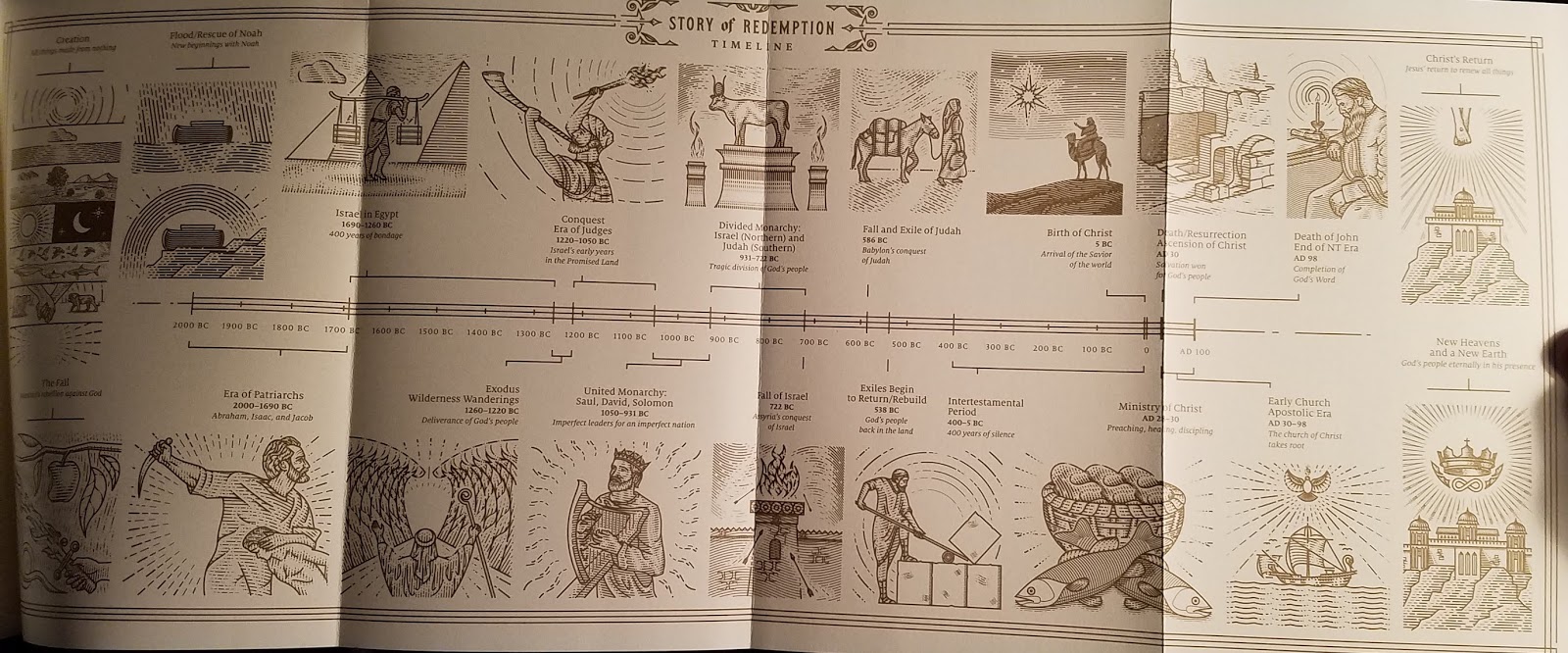
  • One feature I truly like is the simple "Story of Redemption Timeline" as the very last layout....a four-page spread!  It's not too complex, but allows the reader to get a simpler glance to the Bible's history in a single layout.
  • Overall, I think this Bible makes for a great tool for a new / new-er believer who is trying to wrap her mind around what the Bible means from beginning to end.  For the new believer, a traditional study Bible can feel intimidating.  That's certainly not to say this Bible is not useful for a "seasoned" believer, but it's simply not set up as a Bible that can be used to make and find cross references.  Other good study Bibles help make those connections for the reader, but this one is designed with big-picture themes in view.
Overall, I give "The Story of Redemption Bible" 4 out of 5 stars....I knock just one star off due to the lack of cross references.  Otherwise, I like it!

DISCLAIMER: I received this Bible free of charge from Crossway publishers in exchange for my unbiased review of it.  All opinions are mine, and I was not required to provide a positive review of it.

12.17.2018

"Spiritual Leadership", by J. Oswald Sanders (book review)


Are you wondering if you have what it takes to lead? Or are you wondering if you still have what it takes to lead? As J. Oswald Sanders makes clear throughout this book, there is a lot involved in leadership, but even more-so in spiritual leadership. He writes, “It is not a calling we choose to pursue, but is it calling we choose to answer.”

If any of these thoughts strike a chord with you, this book may well be a good resource to consider. In twenty-two chapters (206 pages), J. Oswald Sanders leads the reader through the highs and lows, ups and downs, joys and sorrows of what it means to be a spiritual leader.

Reading this book came at a particularly useful time for me, as I have recently embarked on answering the call to be the interim music director in our local congregation. In short order, many issues and small fires have already surfaced, and I have felt the burden of their increasing weight as these matters cannot continue to go ignored.  So, I was encouraged in reading this book that I am not alone in these struggles, but have a good company and knowing that I can get through them all with the right mindset…and I may even come out the other side as a better leader as a result.

Sanders reminds the reader that:
·         sometimes leadership calls us to cut to the heart and render judgment in difficult situations, while other times decisions require patience and grace;
·         that it is no virtue to be disliked as a leader, but it is also dangerous to pursue being popular;
·         that a true leader humbly serves others and sets them up for success, while poor leaders pridefully promote themselves and their own needs;
·         that good leadership comes at a cost in the form of fatigue, loneliness, criticism, and rejection.
·         that all difficulties provide opportunities to reveal who the true leaders are.

While there are a plethora of very good books pertaining to leadership, this is one of the better books I've read on leadership in the church – “Spiritual Leadership”.  I would highly suggest it to anyone who is considering answering the call to leadership, or to anyone currently in a leadership position who is struggling under its burdens.

No doubt about it, I give “Spiritual Leadership” 5 out of 5 stars!

Disclaimer: I received this book free of charge from Moody Publishers in exchange for my unbiased review of it. I was not required to provide a positive review. All opinions are mine.

12.11.2018

"The Crown Lord, by William Sirls (book review)

"The Crown Lord" is the newest release by William Sirls, in which he attempts to put the racial shoe on the other foot, so to speak. This book found its genesis while Sirls, who is white, was serving time in federal prison with a black roommate. Sirls admitted that their time together helped each of them see less color, and more of humanity.  As a result of their time together, Sirls promised his roommate that he would write a book with a storyline that intended to reverse roles as it pertains to race.

Quite literally, just about everything in the stortline was reversed.... whites were degraded with a slanderous name, stereotypes of whites liking certain types of food and beverages, social ills and pressures, etc.  On the other hand, blacks were in the majority and held the positions of prestige and power, etc.  Imagine all the same actors of today's world just with opposite skin colors.

Unfortunately, Sirls attempt in this book didn't affect me the way I'm sure he had hoped. I didn't find it inspiring nor truly thought-provoking. Instead, it was simply too cliche for me.  Let's be honest, calling whites "pinkies" will never carry with it the same  vulgar undertone that the N-word does. I appreciate his efforts at trying to help white people understand the minority situation by putting the proverbial shoe on the other foot, but it just failed to inspire me.

Additionally, the storyline itself never captured my attention, and therefore never sustained my attention. I honestly struggled to get through this book. That disappointed me, because I really liked his first release, "The Reason".

Another aspect that I didn't like was the especially vulgar language. I'm not opposed to occasional swearing in books or movies, because I know that is real life. But this book was replete with vulgar language, which did nothing for me.  Sometimes crude language can enhance a particular mood or thought, but there was so much of it in this book that it detracted from it instead.

My promotional copy indicates that the book was to sell for $25.95. Barnes & Noble Cary it for just over $23, and Amazon carries it for roughly $17. Unfortunately, I would be disappointed if I paid more than $5 for this book. I appreciate his efforts, but see above.

I give this book just two stars out of five.

Disclaimer. I received this book free of charge in exchange for my unbiased review of it. All opinions are mine, and I was not required to provide a positive review.

10.04.2018

"Girl, Wash Your Face", by Rachel Hollis (review)


Ladies, if you’re captured by the style of Rachel Hollis and “Girl, Wash Your Face”, please know that what you’re NOT going to get are worth consideration.  But first…

What you’ll get: Enthusiastic, entertaining, honest literature from a gal who is probably a lot of fun to hang out with.  She addresses some pretty difficult issues that many in our culture would be embarrassed to address, and she does so in a winsome way.  Rachel herself read the book, and her style is excellent.  But that’s about as far as I’d go for the benefits of this book.

What you won’t get: Good theology.

The issues: From the very first pages, Hollis makes it clear that she believes all of life is in OUR control, YOUR control. This book is for YOU, all about YOU, and it’s up to YOU whether you succeed or fail.  YOU need to be your own hero.  Hollis said, “God, mama, and your partner can’t change you without your help.”  But this is not true.  While mama and your partner can’t change you, God certainly can.  He doesn’t need us to waive our green flag of permission to do as He wills.  But sadly, Hollis’s view of God is an exceptionally low one.  A book that focuses readers on all-things-ME – what I need to do or stop doing or start doing again or start thinking or stop thinking, etc. is highly problematic and selfish.

For being a “Christian” title (published by Thomas Nelson), the gospel of Jesus Christ was completely absent.  Sure, she occasionally used words like “God” and “church” and “Christian” and “faith”, but there was little to no substance behind their use.  She quoted a couple passages from the Bible, but used them out of context.   The ones I remembered were, “I can do all things through Christ who gives me strength”, and “He who began a good work in you will complete it.”  The misapplications were the usual ones, passages used to suggest God will help you attain YOUR dreams…YOU just need to keep reciting the right words (or mantras, as she liked to call it) to yourself.  To call this a “Christian” book is a misnomer.

Here’s the big issue: Hollis failed to point readers to the true Jesus, plain and simple.  Instead, she went so far as to suggest that there is no one right religion or religious view.  This, then, takes the gospel of Jesus Christ off the table, which, therefore, means there’s no directing the readers to repent from sin, no calling readers to trust in Jesus, and there’s no urgency to awaken readers to be right with God through Jesus Christ.  Sure, she talked about “faith” and such, but never really explained what that means. Regrettably, this could be interpreted by any person to be faith in literally anything.    
As an aside, here’s a hint for future reading and listening ventures: When you read/hear key words and phrases like "be a better version of yourself" or "my truth", etc., (which were used repeatedly) be on guard.  We aren’t told anywhere in Scripture to attain to a better version of ourselves, but to humble ourselves, repent from sin, and follow Jesus.  Sinners are powerless in and of ourselves to defeat sin and make us an inkling better.  Instead, we need God the Father to call us, the Holy Spirit to quicken our dead selves, and Jesus to be our substitute.  Additionally, statements such as “This is my truth” is one rooted in relativism, suggesting that what’s true for you may or may not be true for me, and vice versa.  This takes the proclamation of the true gospel of Jesus Christ off the table because, in Hollis’s opinion, Jesus is just one avenue among many as possibilities to better ourselves…if that’s possible.

To conclude, I want to express how I’m honestly heartbroken for Rachel.  It is clear throughout her book (as well as in the interview at the end of the audio version), that her ultimate goal – her driving passion in life – is to be a “mogul”, to be on the cover of Forbes as a top female entrepreneur.   Sadly, she never said she desires to live a holy life in conformance to Christ, never mentions joyfully being made be right with God through Jesus Christ, never mentioned repenting from sin, etc.  Instead, her pursuits appear merely materialistic, endeavors for fame and fortune that will fade with time.  Instead, what we all need is Jesus Christ.  We need his perfect mediation because our sins so deserve God’s punishment.  We need the hope that only the gospel of Jesus Christ gives in being right with the Father.

While my while my heart breaks for Rachel, my ire falls on “Christian” publishers like Thomas Nelson for bowing – once again – to the almighty dollar for printing what sells, rather than printing the true gospel of Jesus Christ.

9.04.2018

"Spiritual Maturity", by J. Oswald Sanders (book review)


I am always blessed in Reading the works of dead theologians. While brother Sanders only passed on to glory in 1992, yes his words remain helpful today.


This book is divided into three parts.  Part one is entitled, “The Overruling Providence of God”, and deals with the character of the first person of the Trinity: God the Father.  Part 2 is entitled, “The Supreme Vision of Christ”, and handles the second person of the Trinity: Jesus Christ. Finally, part 3 is entitled, “The Spirit - the Breath of God”, and obviously discusses the third person of the Trinity: the Holy Spirit.

Each part contains 7 stand-alone chapters, meaning one does not necessarily need to read chapter one in order to understand chapter 2 in order to understand chapter 3, etc. That point was clearly stated in the editor’s Forward, so I decided to read successive chapters from each of the three parts in numerical order. For example, after reading chapter one on the Father, I read chapter 8 on the Son, then chapter 15 on the Holy Spirit. Then I proceeded reading chapters 2, 9, and 16, until I finished the entire book in such a sequence.

I was truly blessed and challenged by numerous thoughts Sanders penned throughout the book, but the chapter that most profoundly influenced me and captured my mind was Chapter 3, “The Undiscouraged Perseverance of God”. In that chapter, brother Sanders detailed several nuances from Genesis 32 as it pertained to the God of Jacob.

Pay attention to these words of his, "The god of Jacob. No two characters seem more ill-matched. No single sentence more strikingly illustrates the undiscoverable perseverance of God."  As we know, Jacob was a schemer and a deceiver (not much unlike us, I might add), and yet brother Sanders does a marvelous job encouraging the reader in the gospel as we struggle with our own sinful flesh. He wrote, “The perseverance of the saints is possible only because of the perseverance of God." 

As I struggle in my own sin, I was encouraged my brother Sanders’ words, “[God] does not despair of us even when we despair of ourselves. His patience is never at an end. His resources are never exhausted.”  Praise God!  Brother Sanders continues, “The devil preaches a message of despair...God is preaching the gospel of recovery. The God of Jacob is pre-eminently the god of the second chance to Christians who have failed and failed persistently.”

O brothers and sisters in Christ, what a truly glorious encouragement in the gospel this chapter and the entire book was! The Gospel of Jesus Christ is proclaimed from front to back, something that is so necessary in our regular reading.  Pick a copy of Spiritual Maturity up for yourself, and you will not be disappointed.

RATING: 5 stars.

DISCLAIMER: I received this book free of charge from Moody Publishers in exchange for my unbiased review of it. All opinions are mine, and I was not required to provide a positive review.

8.13.2018

"Prayer: How Praying Together Shapes the Church", by John Onwuchekwa (book review)


Prayer: it's vital to the Christian life, yet is so often neglected.  This little book from the 9Marks series is an encouragement to the church, and applying brother Onwuchekwa’s suggestions would yield positive results.   For those who may be tempted to think they don’t need to read yet another book on prayer, please don’t be so quick to write this one off.  This book is not so much a “how-to”, but more of a call to corporate action, to put into practice what we so often put off.

In the early chapters, Onwuchekwa discusses what prayer is and what it is not.  His call to corporate action is warranted because, first, we are the body of Christ, not simply a collection of individuals.  But secondly, when we pray corporately, those who are more mature in faith can instruct those who are less mature in faith what biblical prayer entails.

Brother Onwuchekwa also encourages a revival of the apparently-forgotten “prayer meeting”.  He suggests praying corporately outside of the typical corporate gatherings on Sunday mornings.  He details the many perks to having these kinds of prayer meetings, namely that it can be more formational and instructional.

I did something different with this book.  Rather than make underlines, I took notes on it.  When I finished reading it, I scrolled by through my notes to re-read it all.  As I did, three points stood out (to me) above the rest.  (Disclaimer: others may find other points more crucial.

First, Onwuchekwa wrote, prayer is calling on God to come through on what He has promised.  This statement came in chapter 2 as he was discussing what prayer is and is not.  The reason; I found this statement to be so helpful is because we often get in a rut of praying for little things like Aunt Betty’s big toe, or my mother’s sister’s unlce’s brother’s cousin who is having a root canal, rather than praying for more urgent kingdom matters.  We know God cares deeply for Aunt Betty and that distant relative, but we also know that He is concerned more for the condition of our souls more than for our comforts.  When we pray what God has promised, we know we pray His will, AND it requires us to have and seek a deeper theological understanding of God’s word.

A second statement that punched me in the face was found in chapter 4, as he encouraged readers to pray for provision, pardon, and protection.  He wrote, To neglect a single day of praying for forgiveness suggests we are ok with God based on our performance.  I so often fall into the trap that even though I know my works don’t save me, I think my good behavior for a while after a fall makes me ok with God again.  It’s as if I think of God as a forgetful parent who threatens discipline in the family car on the way home from vacation, but then is assuaged when I help fold the laundry.  Not so with God.  Instead, even though we are in Christ by His completed work, I ought still be daily asking for God’s pardon....not a reducing the fines, not a delaying of the fines, but a complete pardon for my sinful offenses.

Third, and finally - also in chapter 4 - Onwuchekwa wrote, We run out of things to pray about when we pray vague prayers for vague people.  Here was his point: when we pray for each other, we ought to pray specifically about how God can strengthen brother Joe to live a holy life.  Instead of asking God to simply strengthen him, we ought to pray things like, “God, give Joe the strength to resist the allure of porn”, or “God, remind Sally to control her tongue next time she wants to lash out at her children”.

Rating:This has truly been a helpful book, and I plan to share it with my pastors and elders.  I give this one 5 out of 5 stars.


Disclaimer: I received this book free of charge from Crossway in exchange for my unbiased review of it.  All opinions are mine, and I was not required to provide a positive review of it.

7.19.2018

"Resurrection Life in a World of Suffering", edited by D.A. Carson and Kathleen Nielson (book review)


This relatively brief book is essentially the reproduction of messages spoken at the 2016 Gospel Coalition Women’s Conference.  The speakers/authors were/are Kathleen Nielson, Jen Wilkin, Carrie Sandom, Mary Willson, D.A. Carson, and John Piper.  That said, you can find the audio of those plenary sessions here.  You may be interested in one, or the other, or both. For the sake of simplicity, I’ll refer in my review only to the book.

The topic of the book is Peter’s first epistle, and the authors provided an excellent, in-depth exposition of the Holy Spirit’s teaching through Peter on the purpose and value of suffering.

In the introduction, Juan Sanchez provided an extremely thorough explanation of the gospel of Jesus Christ.  It was rather long for an introduction for my tastes.  Since it detailed the gospel so clearly, however, I’d prefer it be long and accurate, rather than short and unhelpful.

In chapter 1, “Born Again to a Living Hope”, Kathleen Nielson explains 1Pet 1:1-12 to help readers understand who we are in God’s eyes, that it is He who gives us our Identities.

In chapter 2, “Living Resurrection Life”, Jen Wilkin exposits 1Pet 1:13-2:3, reminding Christians in suffering to hope fully, be holy, fear rightly, and love earnestly.

In chapter 3, “Remember Who You Are”, Carrie Sandom digs into 1Pet 2:4-10 to remind us that Christians are God’s holy people, set apart for His glory, to resist evil and do good in Christ Jesus.

In chapter 4, “Following Jesus Far From Home”, Mary Willson launches out from 1Pet 2:11-3:12 to remind believers of our status that while we are seemingly far from home, we are never far from God.  Therefore, we have a distinct way of life that ought to follow from our identity in Christ.

In chapter 5, “Sharing Christ’s Sufferings, Showing His Glory”, D.A. Carson encourages readers through 1Pet 3:13-4:19 that just as Noah and his family were saved through water (not from water), so too, we must endure sufferings as opportunities to show the glory of God.

In chapter 6, “A Shepherd and a Lion”, John Piper teaches from 1Pet 5:1-14 that this Christian life of suffering, reflecting the glory of God, and pressing on to resist the roaring lion will never make sense to the world’s sensibilities.

I was most helped by this last chapter, wherein John Piper asked (and helped answer) the question, “Is the Devil really in charge of suffering?”  Piper lays out clearly that although the Devil roars in fury against God’s people, he does so only because he’s given permission to do so by our sovereign God.  If all suffering and testing is permitted/intended by God to refine His people like the flames refine gold, so too, the Devil roars violently because he knows that his roaring is only proving to refine the people of God…the very people he hates and seeks to destroy!  I find great hope and joy in knowing that God is sovereign, even over my suffering and trials. 

RATING: I give this book 5 stars, as it is gospel-driven and useful for teaching and encouragement.

DISCLAIMER: I received this book free of charge from Crossway in exchange for my unbiased review of it.  All opinions are mine, and I was not required to provide a positive review.

7.12.2018

"The Essential Jonathan Edwards", by Owen Strachan and Douglas A. Sweeney (book review)


"The Essential Jonathan Edwards", by Owen Strachan and Douglas A. Sweeney, was a considerably worthwhile read!  It is as thick mentally as it is physically (448 pages).  Therefore, much is covered in this book that requires a considerable amount of thought, but you will be blessed in doing so.

Basically, the book is laid out in such a way that the authors focus on a general category in each chapter. Their discussion is built around an analysis of Edwards’ sermons and/or essays.  Helpfully, the authors brilliantly reflect at the end of each chapter on how Jonathan Edwards’ position or circumstance (as discussed in the chapter) could influence our lives today. This, quite honestly, was probably my most favorite aspect of the book.   They did not neglect to discuss how we might think about particular topics today.  

Interestingly, I suppose there are three different ways someone could read through this book.

First, and most obvious, is reading it cover to cover in the order presented. This is obviously a heavy undertaking, but certainly proves helpful.  However, with so much information, much could be forgotten by the time the reader reaches the last pages.

A second approach could be reading just the numerous excerpts from Jonathan Edwards’ sermons and essays alone, without reading Strachan’s and Sweeney’s conclusions, discussions, or commentaries.  The reader could undertake sifting through Edwards’ challenging wording, and grow as a result.

A third reading approach could be to skip all of Edwards’ excerpts, and read just the authors’ commentaries.  They did such a fine job clarifying Edwards’ meanings, as 1700’s language is considerably different from modern English.  Therefore, without even reading his own words , one could still learn from Edwards through those who have taken great care in studying his life and teaching.

One chapter that piqued my interest pertained to Edwards’ view of the trinity. While his approach appeared problematic to me on a few levels, I gave this singular chapter more consideration than the others, as I sought out Edwards’ previous writings on the trinity, as well as writings of those who dissent with his view.  This highlights another positive aspect of this book.  The authors did a fine job citing each sermon and essay so you – the reader – could search out their full contexts yourself.

If you are a Jonathan Edwards aficionado, then this book would probably be a good purchase for you.  I don't consider it a “must-have” book for everyone, but I think anyone who reads it will be challenged, encouraged, and blessed by it. That said, I give this title five stars

Disclaimer:  I received this book free of charge from Moody Publishers in exchange for my unbiased review of it.  All opinions are mine, and I was not required to provide a positive review.

6.25.2018

"ESV Archeology Study Bible" (book review)


I’ve spent a considerable amount of time rifling through and perusing the various options of this Archeology Study Bible.  So, now it’s time to provide information to you regarding what it contains.

First: The version I am reviewing was the English Standard Version (ESV).  The purpose of this review is not to detail the reliability or pro’s and con’s of the ESV, but to detail some of the features the editors have included in it to make it an Archeology Study Bible.

Second: While most study bibles contain interpretive assistance based on a particular approach to theology, this study bible takes its approach from – obviously – an archeological standpoint.  The editors provide several insights pertaining to the origins and even some similarities of other ancient, non-biblical writings.  These commentaries aren’t intended, I don’t believe, to give “authority” to those writings, but to show some similarities among the world’s religions.

For example, found in Proverbs 22:17-24:22 is a comment titled, “the words of the wise.”  This commentary references the “thirty sayings” of Solomon.  The commentary provides a reference to the Egyptian Instruction of Amenemope, which appears very similar.  But the cross reference doesn’t stop there, but I also found it over in Psalm 1:3 “He is like a tree.”  Once again, a reference to Amenemope appears.

Obviously, this piqued my interest, as I’m certain it will others.  Examples like these two may inspire others with a history-buff kind of mind to dig deeper into ancient writings.

Third: Color pictures abound!  Often short articles pertaining to a particular archeological find appears, and near it are pictures to assist your mind’s eye.


Fourth: Intertestamental Events Timeline.  Tucked nicely between the Old and New Testaments, the editors have provided a brief, yet helpful, timeline of events that occurred during the intertestamental period of time.  Names like “Alexander the Great” and “Epicurious” will likely ring a bell with most readers.  This timeline helps readers place the biblical timeline in context with world history.


Fifth: Cultural points to ponder.  Randomly throughout this study bible are brief histories of cultural norms, such as what divorce and the temple tax looked like in the 1st Century.  These are helpful, in that they provide background from the original authors’ and readers’ points of view, rather than from the 21st Century.


RATING: Overall, I like the A.S.B., and I give it 4 stars.  It will not be my primary bible for regular use, but it will certainly supplement my studies.

DISCLAIMER: I received this bible from Crossway free of charge in exchange for my unbiased review of it.  All opinions are mine, and I was not required to provide a positive review of it.

5.17.2018

“High King of Heaven”, edited by Dr. John MacArthur (book review)


“High King of Heaven”, edited by Dr. John MacArthur, digs deep into the person and work of Jesus Christ – otherwise known as Christology.  It is comprised of 4 parts, which are subdivided into 23 chapters, each written by a different author.

Part 1 covers the person of Jesus Christ, while Part 2 handles the work of Jesus Christ. Part 3 addresses the word of Jesus Christ, and part 4 concludes the book with the witness to Jesus Christ.

Several chapters were highly insightful, but the chapters that were most beneficial to my soul at the time of reading were Chapter 6, “The Good Shepherd”, written by Steven J. Lawson, and Chapter 23, “Do You Love Me”, written by John MacArthur. I'm certain I could re-read the book in a handful of months again and find other chapters to be beneficial.  It just so happens that these two chapters dealt with topics that I have been personally dealing with lately.

Given that the book is a Christological one, I am somewhat intrigued why two particular chapters – 20 and 21, written by Albert Mohler and Paul Washer, titled, “Salt and Light” and “Counted Worthy”, respectively – were included.   These were no doubt excellent chapters pertaining to believers’ witness in society and the believers’ persecution, but the whole of the book is a study about Jesus, not about the believer.

I know a fine line exists between the two, as we cannot discuss the Christian without also discussing Christ. But we can discuss the person, work, word, and witness to Christ without referring to Christians. The Bible has a lot to say about those four categories of Christology, and as I understand Christology, we want to study about him based on what the word of God teaches us, not based on its effect on man. That said, those were, indeed, two great chapters, but it seemed like they were slightly out of place. Maybe they should have been in the appendix instead.

All in all, I give “High King of Heaven” five stars out of five, and think it would be a good addition to any avid reader’s Library, right next to some other theological commentaries and systematic theology volumes.

Disclaimer: I received this book free of charge from Moody publishers in exchange for my unbiased review of it. All opinions are mine, and I was not forced to provide a positive review.

3.19.2018

“Word-Centered Church”, by Jonathan Leeman (book review)


“Word-Centered Church”, one of many excellent resources in the 9Marks line of books, is a worthwhile title to add to one’s bookshelf.  In fact, some readers may already have this one under its previously-released title, “Reverberation”, from 2011.  I didn’t read the first edition, so I can’t speak to what has been changed, but can speak of the book on its present merits.

As the title so aptly suggests, Mr. Leeman’s intent is to inspire pastors, teachers, and members alike that the Bible – God’s Word – must be the center of our worship, for it is the Word of God that creates His people, gathers His people, sanctifies His people, and sends His people.  It is divided into three parts – Part 1: The Word (Acts; Invites and Divides; Frees; Gathers), Part 2: The Sermon (Exposes, Announces, Confronts), and Part 3: The Church (Sings, Prays, Disciples, Scatters and Once Again Gathers).

Jonathan Leeman unashamedly makes the case that Christian gatherings must absolutely be distinct from the world, for God’s Word is different from that of the world.  God’s Word reveals to us that God that God is holy, that we are sinners, that God’s wrath over sin looms over sinners, that we need a Savior, that Jesus Christ is that one-and-only Savior, and that we will all face God’s judgment – either with or without Jesus as our Substitute.

This book is full of helpful insight for not only pastors/elders, but also for small/community group leaders and church members alike. 

For pastors, it will serve as a solid reminder that leaning on worldly church growth models is a hopeless endeavor.  While numbers may increase for a season, what will personal growth be built upon, new programs, cool music, merely motivational sermons? 

For community group leaders (and this hit home with me), this book is a strong reminder that we Christians are brought together by the Word of God, and we gather corporately and in small groups under the Word of God.  Like the pastors, community group leaders should be focused on reminding members of the group of the gospel, of the hope we have, and of the joy of sins forgiven.  It reminds us to pray God’s word together.

Finally, for the church and community group member, this book helps establish a strong foundation that we ought to be looking for God’s Word in our large and small gatherings, and that our worship and daily lives must be centered on His Word.  To expect new programs, cool music, or merely motivational speeches misses the mark of the true gospel of Jesus Christ.  We are not saved by or for the next greatest song; we are saved only by the life-giving gospel of Jesus Christ, and the gospel is revealed to us in God’s Word!

In other words, the Word must be the center of all we do as disciples of Jesus Christ.

Rating: I give “Word-Centered Church” 5 out of 5 stars.  It contains both rich theology AND practical application to daily living.

Disclaimer: I received this book free of charge from MP News Room (Moody Publishers) in exchange for my unbiased review of it.  All opinions are mine, and I was not required to provide a positive review of it.


Jonathan Leeman

3.16.2018

“Savage Jesus”, by Steven Furtick (message examination)


I am not a follower of Steven Furtick, but a friend is.  He recently attended one of Elevation’s services, so I wanted to listen in.  I understand he says many helpful things; but his theology is not very good.  What Steven Furtick said in this particular instance is troubling.  Here we have yet another highly influential preacher undermining God’s word, reducing it to make it something altogether different. 


“When Jesus shows up, demons tremble…dysfunction has nowhere to run…and we came to declare today to every evil spirit in our city: ‘Come out in the name of Jesus’.”  (Continuous applause) (21:40 to 22:00).

“How many times have you been to church, possessed by this demon – Don’t get caught up on ‘demon’; I know some of y’all are so scared right now looking for the exits, ‘We’re not going to do anything like that’.   If you make this Bible passage about demons, you missed the entire demonstration of authority because we don’t call it ‘demons’ anymore.  In the ancient world, everything was a demon.  Runny nose – demon! (audience laughter)  I’m serious!  Mental illness was demon.  They didn’t have tests and pills and all this, so it was just a demon.  Now, do demons still exist today?  Yes, but do we call them ‘dysfunctions’ instead?”  (22:13 to 24:00).

I want to know this: If Jesus was, in fact, talking to a “dysfunction”, then how did the “dysfunction” answer him?  How does dysfunction vocalize an answer?  Instead, Mark the gospel writer, makes it abundantly clear that Jesus spoke to the literal demon.  It may have even been multiple demons in the man, since the demon asks, "What do you want from us, Jesus of Nazareth? Have you come to destroy us?"  Or maybe there were multiple demons in the crowd, and this one was the "spokesman", so to speak.  Nevertheless, not to be confused with it being a mere state of mind or condition, Mark tells us clearly the demon actually replied to Jesus. 

While Jesus was speaking to the man, He commanded the literal demon within the literal man.  He said, “Be silent, and come out of him.”  The “him” referred to in that passage was the literal man.  Then in verse 25, Mark explained that the demon convulsed the man, crying with a loud voice as it left the literal man.  The people then exclaimed that Jesus’s authority was so authoritative that even unclean spirits obey his command!  Once again, Mark is clear that this is a spirit; literally, a demon – not a dysfunction or psychotic condition that can be treated with pills or changed behavior.

I am making no judgments on the man’s soul or position before God.  However, if you’re a listener/follower of Furtick’s, be very careful….extremely careful.  Don’t get caught up in his charisma and flashy-ness, but feast on the true Word of God as clearly revealed in Scripture.  May Jesus Christ be glorified in the preaching, reading, studying, and singing of His Word; not minimized.

2.23.2018

"The Hidden Enemy", by Dr. Michael Youssef (book review)


I’ve listened to and had moderately followed Dr. Michael Youssef in past years.  Having a general understanding his background, I thought this title would be interesting to read and review.  At the outset, however, I’ll let you know that this book wasn’t one of my favorites.  It wasn’t bad – not by any stretch of the imagination – but it was just kind-of ok.

The premise of the book surrounds the problems facing us (apparently Western civilization?) today, both externally and internally.  Externally, we have threats coming from radical Islamists who seek to establish Sharia law globally, while internally our media propaganda is another. 

Yet, I found it difficult to distinguish exactly WHO Dr. Youssef was referring to when he explained these threats.  Was he referring to the Church?  Or was he referring to America, to Western civilization as a whole?  I wasn’t exactly sure, because there were some aspects where Dr. Youssef pointed to the fact that the Church will not be overcome by the Enemy…yet he frequently spoke of Islamists and Media gnawing away at our civilization. 

For example, on page 125, he writes, “Let’s not be cowed into silence by those who seek to conquer our civilization” (emphasis mine).  Just two pages later he writes, “How can we defend our civilization (emphasis mine) against the Islamists who seek to conquer us?”  Here’s the issue: Nations rise and fall at God’s direction.  None arises a moment sooner than He commands, and not a single one will last even one second beyond God’s decree.  The Bible and God's timetable of events is not centered on Western civilization; nor should our theology.  

The resounding passage of the book came from John 14:6 – “I am the Way, the Truth, and the Life. No one comes to the Father except through Me.” – Jesus.  While Dr. Youssef frequently quoted and explained (albeit, very softly) this passage, especially in the light of the current trend that our civilization seems to think all paths are equal paths to God, I was left wondering if an unbeliever reading this book would understand the gospel of Jesus Christ. 

Although Dr. Youssef spoke of Jesus dying on the cross for sin, he didn’t clearly explain why the death of Jesus was necessary in the first place.  It came across as, "Jesus died for sin?  Oh, what a nice gesture."  I would have liked to see just one chapter devoted to the big story of the atonement.  I would have liked to see Dr. Youssef explain in more detail God’s holiness, our sinfulness, and our being under God’s wrath for sin.  I would have liked to see him explain that Jesus’s death was necessary to save sinners, because it is only the righteousness of Jesus that covers us as God looks upon us in His holy judgment of us…thereby taking readers to John 14:6. 

Instead, there was just the soft, easy gospel approach that is all too common in the West.  It wasn’t heretical theology; just soft.  That said, I know and believe God is faithful to use His word to accomplish His purposes to His glory, even where and when we are flawed or limited our presentation of it.  So, I can at least give Dr. Youssef credit for not altogether ignoring it.

Overall, the book was an easy read peppered with current events that support his position about the enemies proposed at the beginning of the book.  I’ll not spoil the end of the book, where he explains who the “hidden” enemy is.  It wasn't a surprise, but if you're still interested in reading it, then it at least won't be spoiled by me.

Rating: I give this one just 2 ½ stars.  It wasn’t bad, but I simply wasn’t interested, and it didn’t keep me deeply engaged, and the gospel message could have been better presented.  I certainly would have been disappointed if I had paid the suggested $16.99 for it.


Disclaimer:  I received this book free of charge from Tyndale House Publishers in exchange for my unbiased review of it.  All opinions are mine, and I was not required to provide a positive review.

1.27.2018

"Long Before Luther", by Nathan Busenitz (book review)


Nathan Busenitz, in "Long Before Luther", seeks to answer the question, "Did the early church teach justification by faith, or was it a 16th-century invention of the Reformers?" 

Throughout 11 chapters and 164 pages, Busenitz makes it very clear that "examples abound of authors who used the language of 'faith alone' to describe salvation'" (p.161).  Not only did they describe salvation as such, but authors also wrote of the distinction between justification and sanctification, as well as the "Great Exchange": the righteousness of Christ imputed upon the sinner, and the sins of the sinner imputed upon Christ.

Regardless of whether the early church fathers wrote as they did, the Reformers' first appeal was to scripture, the final authority of all matters of faith and doctrine.  There, they drew upon Jesus and Paul, finding full assurance that the Scriptures taught justification by faith.  One such example to support their theology looked like the thief on the cross, who found justification without performing a single work.

One of the neatest chapters was the appendix, "Voices From History", where Busenitz quotes from several church fathers, tracing them through the centuries, beginning with Jesus, Peter, Paul, and John.  The list also includes Clement of Rome and Polycarp (1st and 2nd centuries) through the years to Jerome and Augustine (4th century), Julian of Toledo (7th century), and Bernard of Clairvaux (12th century), etc.  Each century is represented, and it is truly interesting to see how opponents of sola fide can claim the church fathers never taught such a thing.

But, as Busenitz shows, sola fide has been taught long before Luther.

RATING: I give "Long Before Luther" 4 out of 5 stars.  It was very good...very informative...but not a page-turner.  There was a lot of redundancy, but I suppose the redundancy was necessary since so many church fathers taught sola fide.  It's also good to be repeatedly reminded of the doctrine so that different wordings help it sink in.

DISCLAIMER: I received this book free of charge from Moody Publishers (MP Newsroom) in exchange for my unbiased review of it.  All opinions are mine, and I was not required to provide an unbiased review of it.